


I want to clear something up right away, because I see this confusion all the time. A lot of packaging suppliers throw around the term "OEM" like it's just a fancy way of saying "we make boxes." It's not. An OEM manufacturer does something fundamentally different from a regular box supplier, and once you understand the distinction, you'll never look at packaging sourcing the same way again.
OEM stands for Original Equipment Manufacturer. In the world of dates packaging, a true dates packaging OEM manufacturer doesn't just print your logo on an existing box template. They build the entire packaging solution from the ground up, to your exact specifications. Your dimensions. Your materials. Your structural design. Your finishing choices. Everything is created for your brand and your brand only.
Why does this matter? Because dates aren't a one-size-fits-all product. A Medjool date from Jordan is completely different in size, oil content, and market positioning from a Deglet Nour from Tunisia. A premium Ramadan gift box destined for Harrods has nothing in common with a value pack headed to a supermarket chain. An OEM approach means your packaging is engineered specifically for your product, your market, and your brand story. Nothing is borrowed from someone else's spec sheet.
I've spent years working with food packaging manufacturers, and I'll walk you through what a genuine OEM partnership looks like, how it works, and how to find a manufacturer who actually delivers what they promise.
Let's get specific about what you should expect when you engage a legitimate dates packaging OEM manufacturer. Because if you've only ever bought stock boxes or slightly modified existing designs, the OEM process feels completely different—and way more powerful.
First, a real OEM partner starts with questions, not a catalog. They want to know about your dates. What variety? What's the average piece size and weight? How oily are they? What's your typical shelf life from packing to consumption? These aren't idle questions. The answers determine board grade, barrier coatings, insert design, and whether you need grease-resistant lining. A manufacturer who doesn't ask about your product's physical characteristics isn't doing OEM work—they're just taking a standard box and printing your name on it.
Second, an OEM manufacturer offers material development. Maybe you need a specific shade of kraft board that matches your brand palette, and it doesn't exist off the shelf. An OEM partner can develop that with their paper mill. Maybe you want a custom texture—a linen finish, a sand-like grit that evokes the desert where your dates are grown. That's achievable through OEM channels. These aren't off-the-shelf options. They're created for you.
Third, an OEM partner handles the entire supply chain under one roof. Printing, die-cutting, gluing, insert fabrication, assembly, quality control—it all happens in their facility. When something goes wrong, there's one throat to choke. No finger-pointing between a printer and a separate box assembler. This single-source accountability is worth its weight in gold when you're on a tight seasonal deadline and something needs fixing fast.
If you've never worked with a dates packaging OEM manufacturer before, the process can feel opaque. Let me demystify it for you.
It starts with a conversation. You share your requirements—box style, approximate dimensions, target quantity, target market, budget range, and any reference images of packaging you admire. A good OEM partner will ask clarifying questions and often suggest alternatives you hadn't considered. Maybe the rigid box you're imagining could be replaced with a heavy-gauge folding carton that achieves the same premium feel at 40% lower cost. An experienced manufacturer earns their keep with suggestions like this.
Next comes the design and engineering phase. Their team creates a dieline—the flat template showing exactly where cuts, folds, and glue tabs will be. They'll also produce 3D renderings so you can see how your artwork looks on the actual box shape. This is the moment to scrutinize every detail. Where does the logo land when the box is closed? Is the window positioned to show the most photogenic side of your dates? Does the insert hold pieces snugly without crushing them?
After design approval, you hit the sampling stage. This is non-negotiable. A physical pre-production sample tells you things that no digital mockup can communicate. How does the board feel in your hand? Does the magnetic closure snap satisfyingly or feel flimsy? Do colors print accurately on your chosen material? Does the box assemble easily, or will your packing team curse you? Order at least two samples—one to keep for reference and one to test with actual dates inside for two weeks minimum. If grease spots appear on day five, your barrier coating needs upgrading.
Only after sample approval does production begin. A reputable OEM manufacturer will provide progress updates, share photos from the production line if you ask, and welcome third-party inspection before shipping.
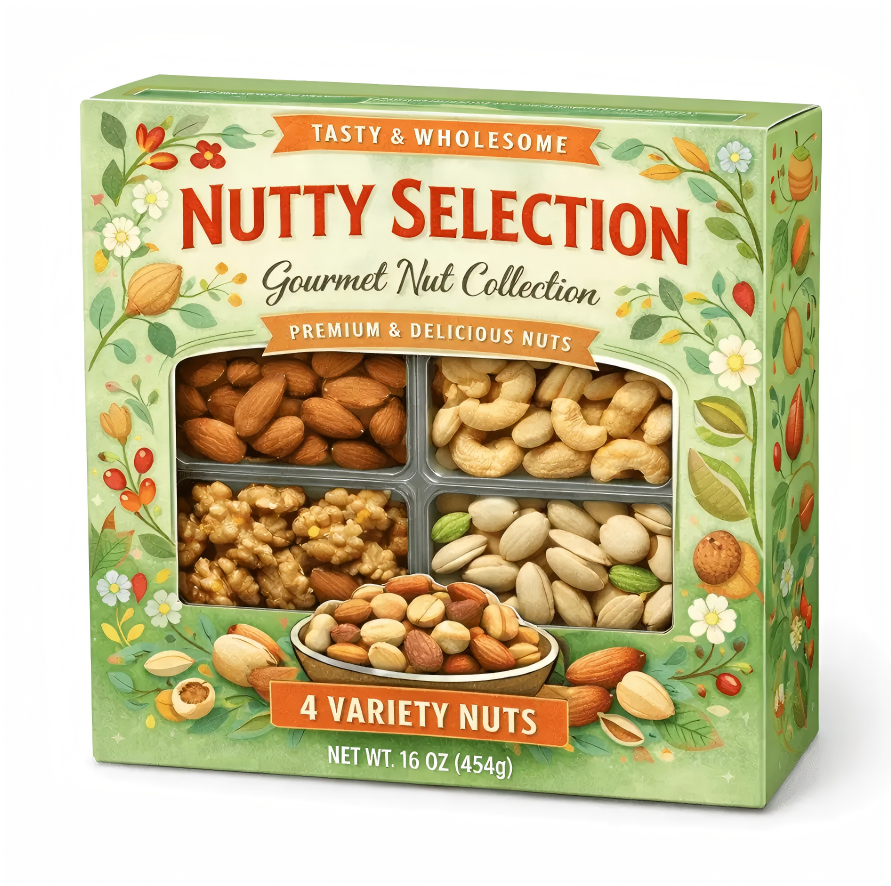
We are also offering finishing options such as glossy and matte look which gives the custom printed candy boxes a final touch. They can add sparkle to your design and also give added protection.
| Feature | Application | Cost Impact |
| Printing: Digital | Small quantities, complex color layouts | Low setup cost, high per-unit cost |
| Printing: Offset | High quantities, precise color matching | High setup cost, low per-unit cost |
| Finish: Gloss Lamination | For a bright, eye-catching look; it also protects | Low-Medium |
| Finish: Matte Lamination | For an elegant, classy, modern look | Low-Medium |
| Finish: Spot UV | To show a logo or highlight a specific design | Medium |
| Finish: Foil Stamping | For products with luxury and a premium feel (gold, silver) | High |
| Finish: Embossing/Debossing | Creating the feel of texture and the 3D effect | Medium-High |
I've noticed a clear pattern in the dates industry. Brands start with stock packaging because it's fast and cheap. And for getting off the ground, that's fine. But there's a growth threshold where stock packaging stops working, and the brands that recognize this early are the ones that break out.
The trigger is usually one of three things. Sometimes it's a retail buyer saying, "We love your dates but your packaging looks exactly like three other brands we already carry. What makes you different?" Sometimes it's a competitor releasing a gorgeous new box design and suddenly your shelf presence looks tired by comparison. And sometimes it's a quality issue—boxes arriving at customers crushed or grease-stained because they weren't engineered for your specific product.
A dates packaging OEM manufacturer solves all three problems. Your packaging becomes genuinely unique, so retail buyers can't compare you directly to competitors. Your design stays fresh and proprietary, impossible for competitors to copy from a stock catalog. And your box is engineered for your exact dates, your exact supply chain, your exact shelf life requirements. No more hoping a generic box works. It's built to work.
The other thing that changes when you go OEM: your packaging becomes a competitive moat. A competitor can buy the same stock box you're using from the same online catalog tomorrow. They cannot replicate an OEM-developed box with custom materials, custom tooling, and custom structural design without significant time and investment. That exclusivity matters.
Not every factory that calls itself an OEM actually operates like one. Here's my checklist for separating the real deals from the pretenders when you're evaluating a dates packaging OEM manufacturer.
Certification is the first filter. Food-grade packaging requires ISO 22000 or BRCGS certification at minimum. If you're exporting to Europe, ask for EU Regulation (EC) No 1935/2004 compliance documentation. For Middle Eastern markets, halal certification for packaging materials is increasingly requested. A legitimate manufacturer provides these documents without hesitation.
In-house capabilities are the second filter. Does the factory do its own printing, die-cutting, and finishing? Or do they outsource some of these steps? There's nothing inherently wrong with outsourcing, but it adds complexity and potential quality gaps. The most reliable OEM partners control the entire process under one roof. Ask directly: "What percentage of production happens in your facility versus subcontractors?" See how they answer.
The third filter is their client portfolio. Ask for case studies or references from dates brands specifically. Packaging for dates is different from packaging for biscuits or electronics. The oil content, weight, and humidity sensitivity of dates create unique challenges that a general packaging factory might not anticipate. A manufacturer who has successfully served other date exporters understands these nuances already.
Finally, pay attention to how they handle the sampling process. Do they push you toward a quick digital approval? Or do they insist on sending a physical sample and following up to confirm you're satisfied? The latter approach signals a manufacturer who cares about getting it right, not just getting the order.
Let's talk numbers honestly, because sticker shock kills OEM projects before they start if expectations aren't set properly.
Working with a dates packaging OEM manufacturer costs more upfront than buying stock boxes. There's no way around that. You're paying for custom tooling—cutting dies, embossing plates, foil stamping dies. These are one-time costs that typically range from $50 to $300 per die depending on complexity. You'll also pay for sample development and possibly design work if you're using their in-house team.
But here's what changes the math: unit costs drop significantly as volume climbs. A custom rigid box that costs $1.20 per unit at 500 pieces might drop to $0.65 at 5,000 pieces. The tooling cost gets amortized across the order. At scale, OEM packaging can actually cost less than premium stock packaging while delivering a completely unique result.
Don't forget the hidden financial benefits. OEM packaging reduces product damage during shipping because it fits your dates correctly. It supports higher retail pricing because the perceived quality matches the price point. And it builds brand equity that stock packaging simply cannot deliver. When you factor in these upsides, the "extra" cost of OEM often pays for itself within one or two production cycles.
My advice: if your annual packaging volume is below 2,000 units, OEM might not make financial sense yet. Stick with high-quality custom printed stock options. But once you cross that threshold, start having conversations with OEM manufacturers. The economics shift quickly in your favor.
A regular box supplier offers existing designs and adds your logo. An OEM manufacturer builds the entire box from scratch to your specifications. That means custom dimensions, custom materials, custom structural engineering, and custom finishing. You're not adapting your brand to fit their box. They're building a box around your brand. The difference in shelf presence is night and day.
Realistically, budget 8 to 12 weeks for a new OEM project. That breaks down roughly as: 2-3 weeks for design, engineering, and dieline development. 2-3 weeks for sampling and your approval. 3-4 weeks for production. 2-4 weeks for ocean freight if you're importing. Rush timelines are possible—I've seen projects turned around in 6 weeks—but everything has to go perfectly, which it rarely does. Pad your timeline, especially for seasonal launches.
No. Most OEM manufacturers have in-house design teams who can work from a rough concept, reference images, or just a conversation about your vision. Some offer design as a complimentary service with an order; others charge a flat fee. What matters is getting the source files at the end so you own the final artwork and can take it to another manufacturer if needed.
Yes, and any good partner will encourage this. Digital printing allows for test runs of 200-500 units without the tooling costs of offset printing. The per-unit price will be higher, but it lets you test the market, refine the design, and confirm the packaging works before investing in full-scale production tooling. Smart brands test before they scale.
Rushing the sampling stage. I cannot emphasize this enough. People feel the time pressure, approve a digital proof, and skip the physical sample. Then 10,000 boxes arrive and the color is wrong, or the insert doesn't fit, or the board feels flimsy. Order the physical sample. Test it with actual dates for two weeks. Check every detail. The extra week this takes is nothing compared to the cost of reprinting an entire production run.
Post time: Jul-01-2026


