


Baklava is not a forgiving product. I'll say that straight out. It's delicate. It's heavy for its size. It's soaked in butter and syrup. It shatters if you look at it wrong. And it's one of the most emotionally significant foods in the world—served at weddings, gifted during Ramadan, shipped across oceans to family members who miss the taste of home. Nobody hands someone a box of baklava casually. The moment matters.
That's why the box you put baklava in carries weight—literally and figuratively. A flimsy box that collapses under the heft of layered phyllo, or one that shows grease stains an hour after packing, doesn't just look bad. It undermines the entire experience. It tells the recipient, "This wasn't worth doing properly."
I've worked in food packaging for a long time, and I can tell you that baklava is one of those products that separates generic box makers from true specialists. Finding a baklava box manufacturer who actually understands the product will change how your brand is perceived. Here's what you need to know.
You might wonder why you can't just order standard pastry boxes or generic food boxes and call it a day. After all, a box is a box. I used to think that way too. Then I saw what happens when baklava meets the wrong packaging.
The first issue is oil. Baklava is soaked in butter or ghee. That fat migrates through paperboard within hours, leaving dark, unappetizing stains on the outside of a box. A generic box—even a high-quality one designed for dry pastries—often has no barrier against this. A specialized baklava box manufacturer builds grease-resistant coatings into the box structure from the start. The coating prevents oil from seeping through, keeping the exterior clean and appetizing for days or weeks, not hours.
The second issue is weight. Baklava is dense. A tray of 12 pieces can weigh a kilogram or more. A box that works fine for croissants or cookies will buckle under that weight. Specialized baklava boxes use thicker board, reinforced corners, and structural designs that distribute weight evenly. The box holds its shape whether it's sitting on a counter, stacked in a display case, or shipped across the country.
The third issue is crushing. Phyllo layers are fragile. The top layer of your baklava is a work of art—finely layered, golden, delicate. Generic packaging that allows the product to shift around during transit will destroy that delicate top. Specialized boxes include inserts or snug-fit designs that hold each piece in place, preventing the movement that causes damage.
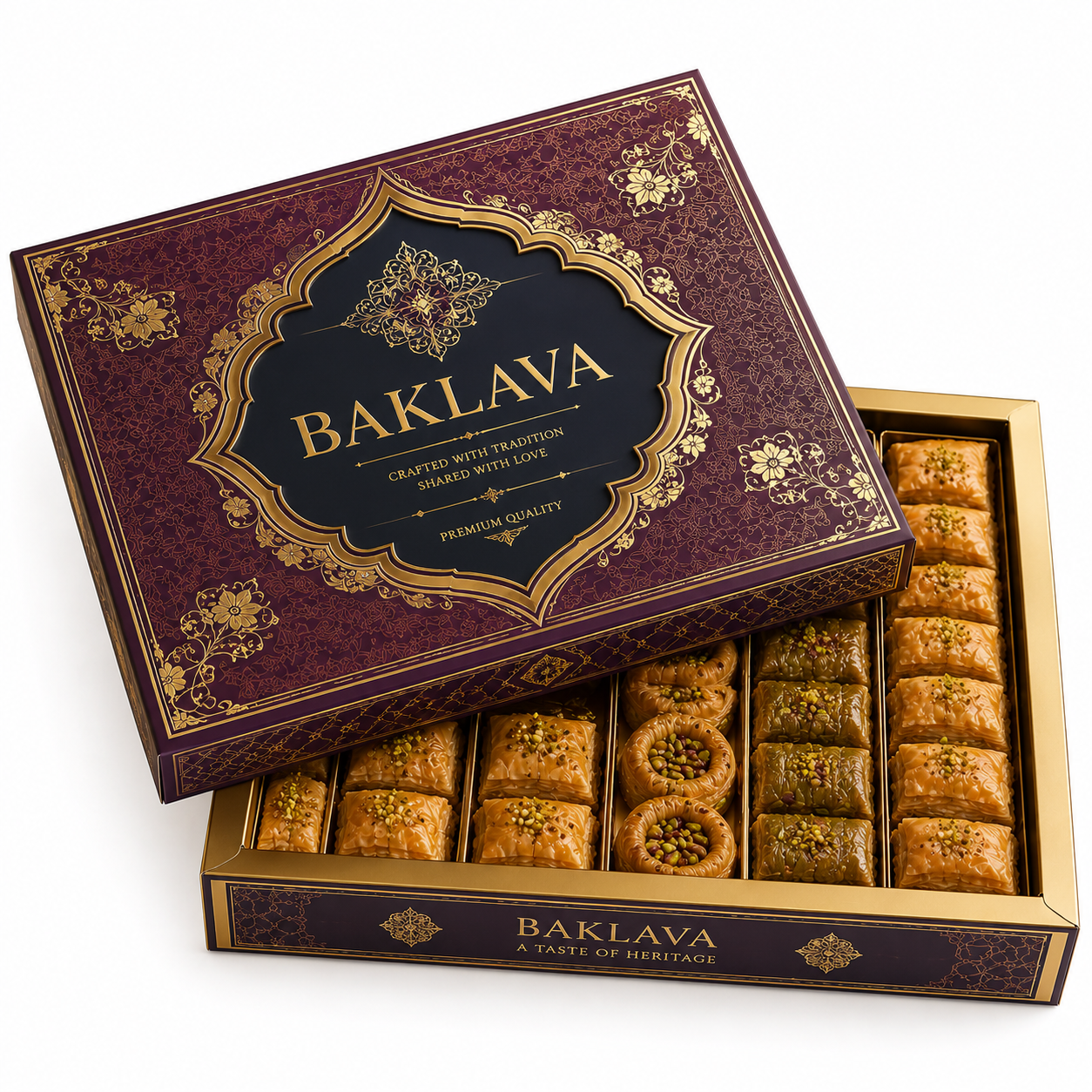
I
When you're talking to a baklava box manufacturer, material selection should be one of your first questions. The right materials make the difference between packaging that performs and packaging that fails.
Grease-resistant board is the foundation. This comes in several forms. Water-based coatings are the most common—a thin barrier applied to the inside surface that blocks oil migration. For heavier, butterier baklava, a PE (polyethylene) liner or PLA (polylactic acid) liner provides stronger protection. Some manufacturers offer specialized greaseproof papers that are laminated to the board. Each option has different cost and performance profiles, and a good manufacturer helps you match the barrier to your specific product.
For the box structure itself, rigid chipboard wrapped in art paper is the premium choice. It's heavy, substantial, and gives that satisfying "thunk" when set on a table. For bakery trays and everyday retail, a high-gauge folding carton with a grease-resistant coating is more cost-effective while still providing solid protection. The board thickness matters—ask about GSM (grams per square meter). For baklava, you want at least 350 GSM for folding cartons, and 800+ GSM for rigid boxes.
Window films deserve attention too. A window lets customers see the glistening layers of phyllo and chopped pistachios—that's a powerful selling tool. But the film needs to be food-grade, firmly attached, and ideally anti-fog so condensation doesn't cloud the view. Standard PVC is cheapest but increasingly rejected by eco-conscious consumers. PLA windows are compostable and perform well. Some brands skip the window entirely and use a beautiful product photo on the box instead.
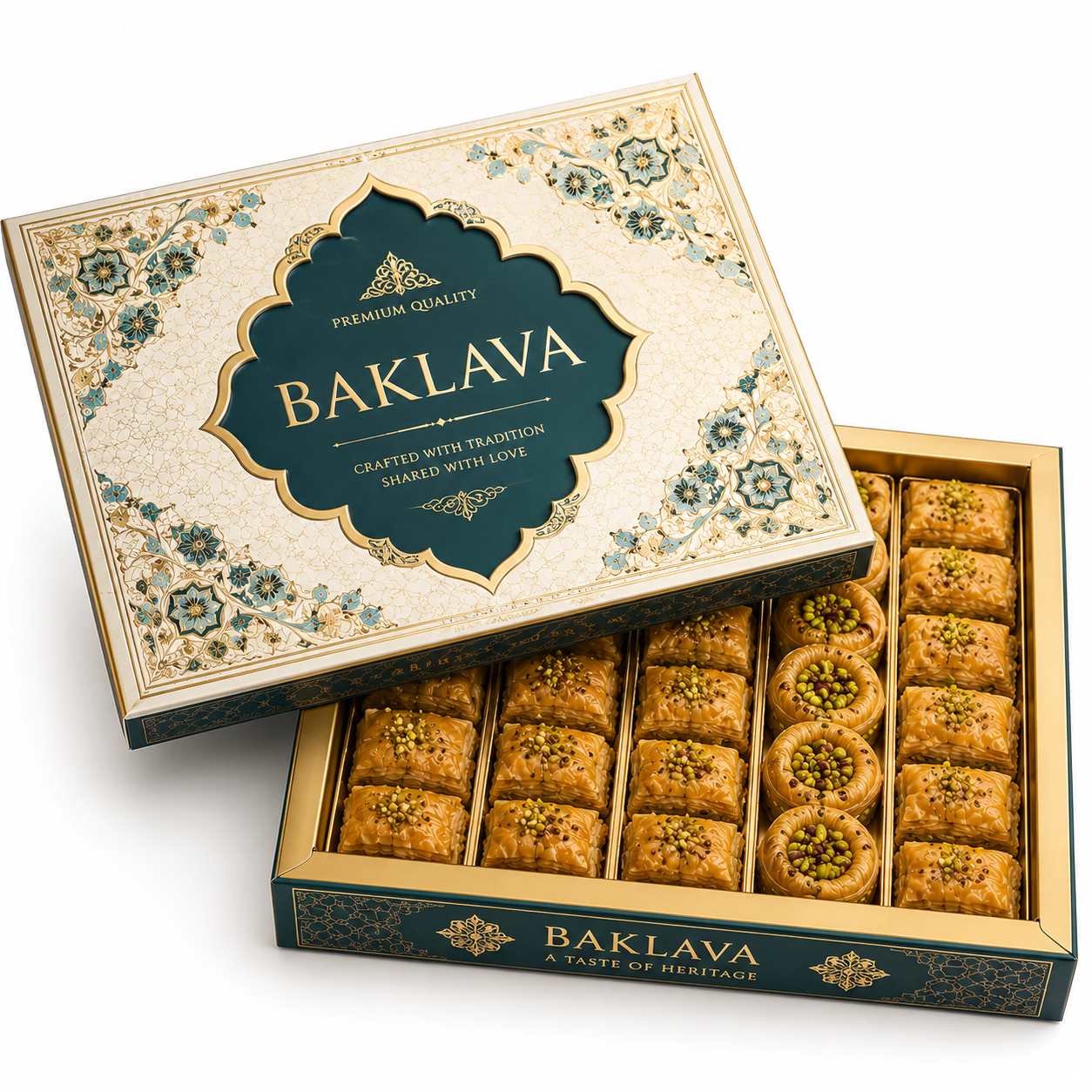
We are also offering finishing options such as glossy and matte look which gives the custom printed candy boxes a final touch. They can add sparkle to your design and also give added protection.
| Feature | Application | Cost Impact |
| Printing: Digital | Small quantities, complex color layouts | Low setup cost, high per-unit cost |
| Printing: Offset | High quantities, precise color matching | High setup cost, low per-unit cost |
| Finish: Gloss Lamination | For a bright, eye-catching look; it also protects | Low-Medium |
| Finish: Matte Lamination | For an elegant, classy, modern look | Low-Medium |
| Finish: Spot UV | To show a logo or highlight a specific design | Medium |
| Finish: Foil Stamping | For products with luxury and a premium feel (gold, silver) | High |
| Finish: Embossing/Debossing | Creating the feel of texture and the 3D effect | Medium-High |
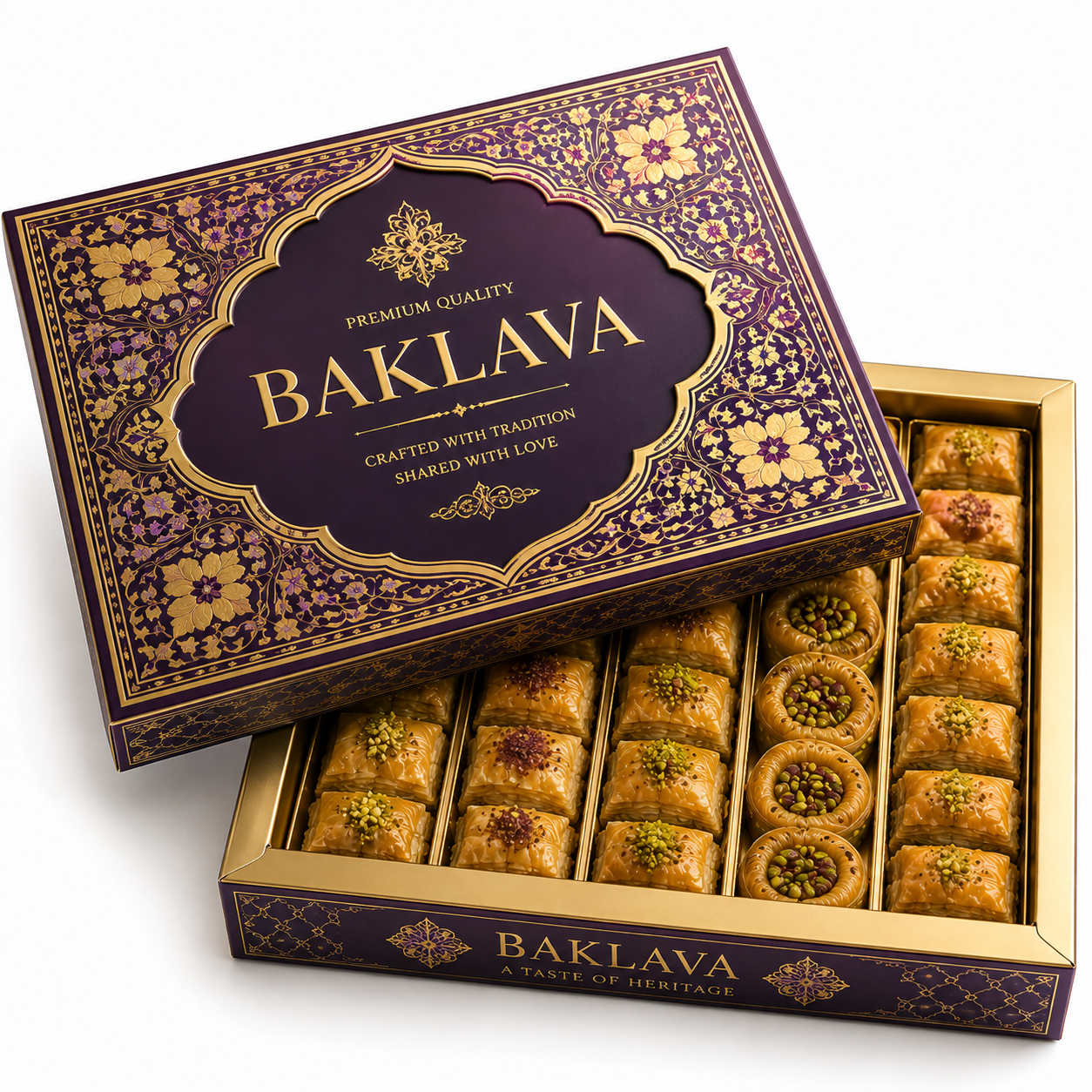
The best baklava box manufacturer partners don't just provide materials—they provide design thinking. The structural and aesthetic choices they offer should be tailored to how baklava is bought, given, and consumed.
Insert design is critical. Baklava pieces need to be separated and protected. A well-designed insert—whether it's folded cardboard, molded pulp, or thermoformed PET—holds each piece in its own compartment. This prevents pieces from sticking together, protects the delicate top layers, and creates a beautiful presentation when the box opens. It also allows for elegant arrangements: concentric circles, diamond patterns, neat rows. The insert isn't just functional—it's part of the visual experience.
Size and depth deserve careful thought. Baklava pieces vary widely. A diamond-cut piece from a traditional Turkish bakery is different from a finger-style piece or a square cut from a tray. Your box needs to be deep enough to accommodate the height of your pieces without crushing the top layer. It needs to be sized so the pieces fit snugly without being forced. A good manufacturer asks about your specific piece dimensions and designs around them.
The opening experience matters more than most people realize. A rigid box with a magnetic closure creates a sense of ceremony—the lid lifts slowly, revealing the baklava like a presentation. A drawer-style box slides open horizontally, which feels unexpected and delightful. A hinged lid that opens like a book creates a different kind of reveal. Each option changes how the recipient feels about what's inside. Discuss these options with your manufacturer and choose the one that fits your brand's personality.
Walk into any Middle Eastern bakery or specialty food store and look at the baklava section. What do you see? Gold. Lots of gold. Maybe some red. Arabic calligraphy. Geometric patterns. It's beautiful, but it's also crowded. Every brand looks more or less like every other brand.
A skilled baklava box manufacturer helps you break out of that visual sameness while staying authentic to the product's heritage. The trick is finding a balance between tradition and distinction.
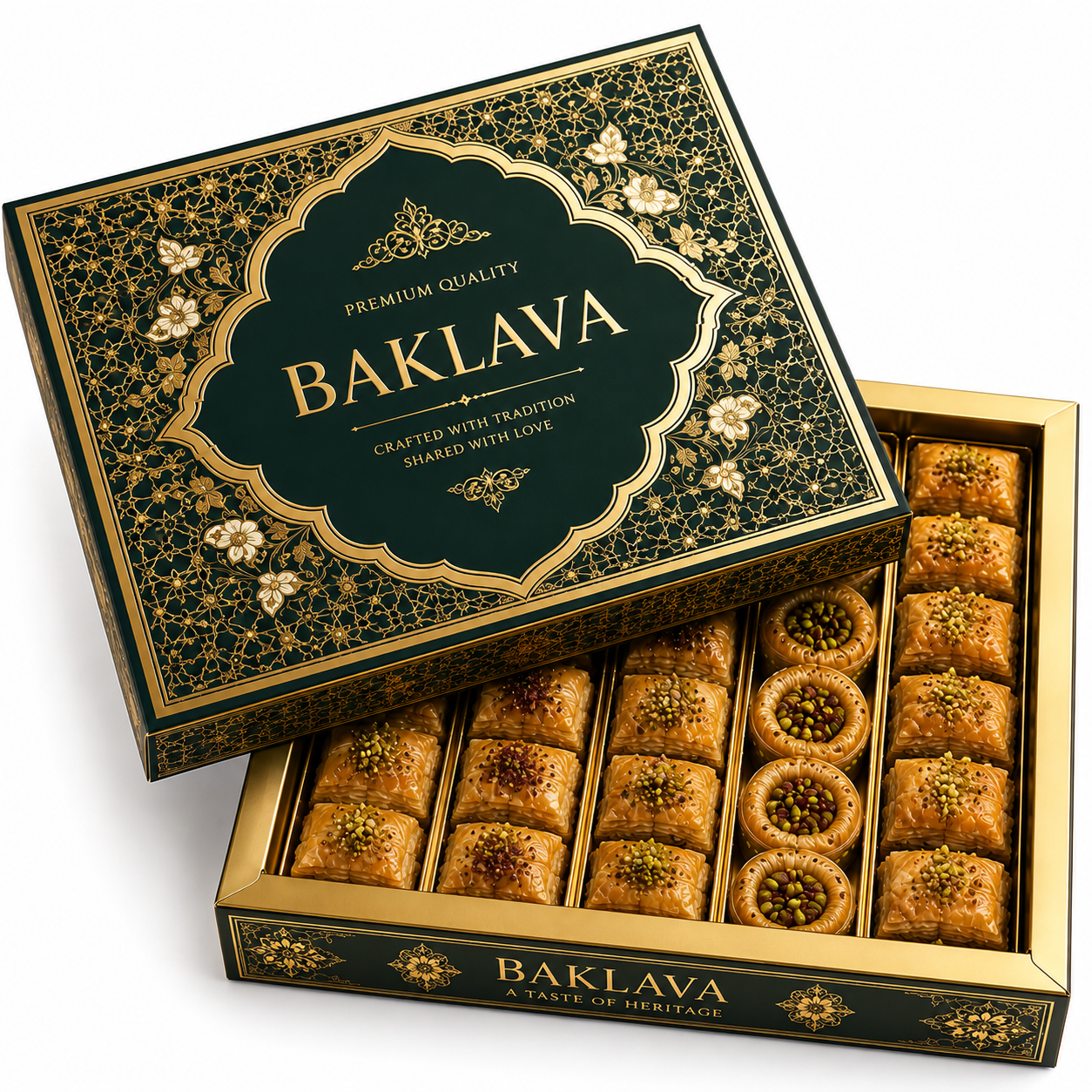
Color is a good starting point. Gold and deep red will always have their place, but consider deep teal, rich burgundy, or matte black as alternatives that read as premium while standing apart from the sea of gold. These colors photograph beautifully and look sophisticated on a gift table. Pair them with one traditional element—a subtle geometric pattern debossed into the board, a thin border of gold foil—and you've got packaging that honors tradition without blending into the crowd.
Typography matters enormously. Arabic calligraphy is gorgeous, but if your target market includes Western consumers who can't read it, it becomes decorative art rather than communication. Many brands pair Arabic script with clean English typography, treating the Arabic as a beautiful visual element while ensuring the product name is readable. Your manufacturer should be able to handle multilingual printing with precision—both scripts need to be crisp and correctly aligned.
The inside of the box is where brands create memorable moments. Print a brief story inside the lid—"Our family has baked baklava in Gaziantep for three generations" or "Best enjoyed with strong Turkish coffee." Add a small note about how the baklava was made, what ingredients were used, or how to store it. These details get noticed, remembered, and shared.
H2: Food Safety and Compliance with a Baklava Box Manufacturer
This is the unglamorous part of packaging that nobody gets excited about until something goes wrong. Then it's all they can think about.
Baklava is a moist, fatty food. That means it's particularly sensitive to packaging that isn't food-safe. Chemicals from printing inks and adhesives can migrate through the board and into the product. The risk is higher with fatty foods because many harmful substances are fat-soluble. A responsible baklava box manufacturer addresses this proactively.
Ask about low-migration inks. These are specifically formulated to minimize the transfer of chemicals from printing into food. They're more expensive than standard inks, which is why cheap manufacturers don't use them. A reputable manufacturer will provide documentation of their ink safety. The same applies to adhesives—glues used in box assembly need to be food-safe and low-migration.
Certifications provide verification. ISO 22000 covers food safety management systems. BRCGS (Brand Reputation through Compliance Global Standards) is recognized by retailers worldwide. If you're exporting to Europe, compliance with EU Regulation (EC) No 1935/2004 is mandatory. For the US market, FDA food contact compliance matters. A legitimate manufacturer has these certifications available and shares them willingly.
Your shelf life testing is also important. Even with proper barriers and safe materials, you should test your packaging with your actual product. Pack baklava in the boxes. Store them as your customers would. Check for grease migration, odor absorption, and structural integrity over time. The best packaging manufacturer will support this testing with samples and guidance.
Let's get practical about finding and working with a baklava box manufacturer, because the sourcing process itself can be intimidating if you've never done it.
Minimum Order Quantities are the first hurdle. Rigid luxury boxes often require 500-1,000 units per design. Folding cartons with digital printing can go as low as 200-300 units. If you're a small bakery, digital printing is your friend—higher per-unit cost but no massive inventory commitment. As your volume grows, offset printing becomes more economical.
Lead times are the second consideration. Production typically takes 3-5 weeks after sample approval. Sea freight from overseas manufacturers adds 4-6 weeks. Customs and inland delivery add another 1-2 weeks. Total timeline: roughly 8-12 weeks. For Ramadan, which is the biggest baklava season globally, start planning 4-6 months ahead. Christmas and Diwali are also significant. The manufacturers worth working with get booked solid during these periods.
Sample approval is non-negotiable. Get a physical sample before production. Check the board weight, the grease barrier, the insert fit, the print quality. Pack actual baklava in the sample and let it sit for two weeks. Check for stains, odors, and structural issues. This testing catches problems before they become expensive production runs.
Finally, discuss logistics with your manufacturer. Baklava boxes, especially rigid ones, don't nest efficiently when assembled. Ask about flat-packing options. A box that ships flat and assembles at your facility saves significant freight costs. And if you're importing from overseas, work with a freight forwarder rather than relying on the manufacturer's shipping quote. Independent forwarders are usually more competitive.
You're using packaging without a proper grease barrier. Baklava's butter and syrup naturally migrate into paperboard. The fix is a grease-resistant coating on the box interior—either a water-based barrier for lighter products or a PE/PLA liner for heavier, butterier baklava. Ask your box manufacturer specifically about oil-resistant options. Then test the packaging with your actual product before committing to a full order.
The answer is a custom insert. Each piece should sit in its own compartment, held snugly so it can't shift during transit. The insert also protects the delicate top layers from being crushed by the lid. Molded pulp, folded cardboard, and thermoformed PET are all common insert materials. A good baklava box manufacturer will design the insert around your specific piece dimensions.
Absolutely, and it's a smart choice—baklava is visually stunning. Ask for food-grade window film with anti-fog properties so condensation doesn't cloud the view. If you're targeting eco-conscious consumers, request PLA film, which is compostable. The window needs to be firmly attached; a window that peels off makes your packaging look cheap regardless of how beautiful the baklava is.
A rigid box is made from thick chipboard (typically 800-1200 GSM) and doesn't fold flat—it's a solid, substantial structure wrapped in decorative paper. Rigid boxes feel luxurious and are ideal for gift packaging. A folding carton is made from thinner board (300-400 GSM), ships flat, and folds into shape. Folding cartons are lighter and more cost-effective for everyday retail. For premium gift baklava, rigid is the standard. For bakery counter sales, folding cartons work well.
Start the process at least 4-6 months before Ramadan begins. Ramadan shifts by roughly 11 days each year, so check the calendar. Design and sampling take 3-5 weeks. Production takes 3-5 weeks. Sea freight takes 4-6 weeks. Customs and delivery add another 1-2 weeks. That's roughly four months minimum, and you'll want buffer for unexpected delays. The best manufacturers book up early for Ramadan season—don't wait until the last minute.
Post time: Aug-18-2026


